
Before You Brief the Board on AI — Answer This One Question About Your Data
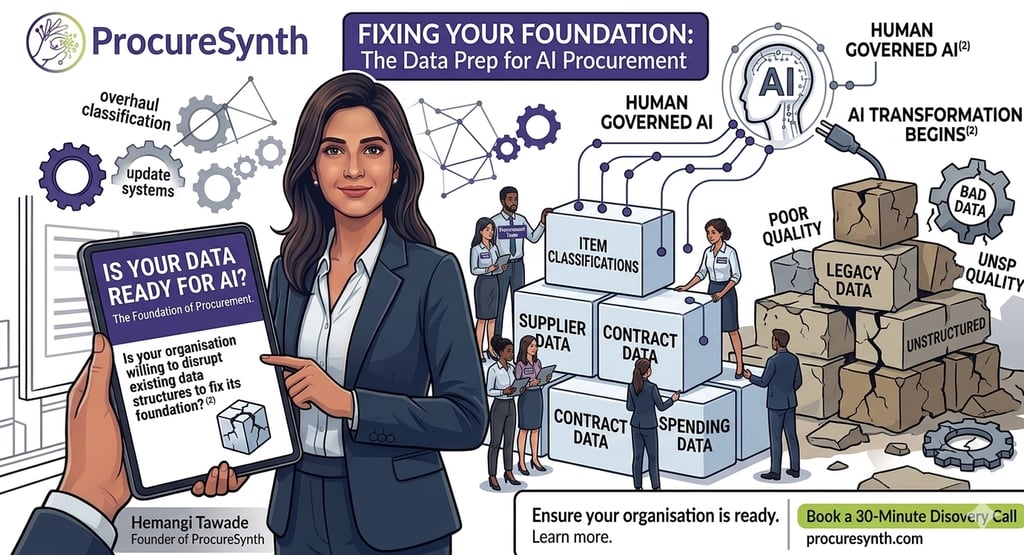
Is your organisation willing to disrupt existing data structures and old ways of working in order to fix its data foundations before your AI transformation begins?
WAR ROOM STORIES
Hemangi Tawade
4/12/20262 min read
My phone lit up mid-meeting. "New CPO has resigned." I read it twice. She had done everything right. What will happen to our new AI transformation in the Procurement vision now? By afternoon, multiple stories were circulating. Then an official statement from the board was released. The board was super careful and appreciated her vision, CPO's outside-in perspective, and modern ways of handling innovation. What could have gone wrong? I kept pondering.
I got a chance to talk to her briefly during the day. We could reflect on certain areas, and one of the major areas that we spoke at length about was Data management.
CPO came from another industry where she had already successfully deployed an AI transformation project within procurement. She was well-versed with AI strategy, what needs to be done and how, she was well-versed with challenges and vendor tools available in the market. She always knew the importance of cleansed data for better results. What she underestimated was the effort and unwillingness in the current organisation to do data cleansing and to make others understand its importance.
"By 2026, 60% of AI projects will be abandoned due to a lack of AI-ready data, a trend already visible as half of generative AI initiatives were scrapped after proof of concept by the end of 2025."
— Gartner, (February 2025). Lack of AI-Ready Data Puts AI Projects at Risk
Poor data quality remains the primary cause of these failures. In procurement—despite controlling the largest share of corporate spend—AI adoption accounts for just 6% of enterprise use cases. Across industry reports and surveys, the conclusion is consistent: without clean, structured, and accessible data, AI investments in procurement will continue to deliver negligible returns.
I sat with both truths simultaneously. As the IT lead, I understood exactly why the organisation couldn't absorb what she was demanding. I also knew she was right — and that refusing to fix the foundation would quietly guarantee the failure of everything that followed.
She wanted to overhaul the PCN structure — the foundation that governed spend classification, supplier data, and contract consistency across the organisation. Without it, AI outputs would be built on sand. She was strategically correct.
But I understood why the organisation resisted. The PCN structure was hardwired into legacy systems across multiple business units. Changing it wasn't a data project — it was an earthquake; nobody had budgeted time or disruption to survive.
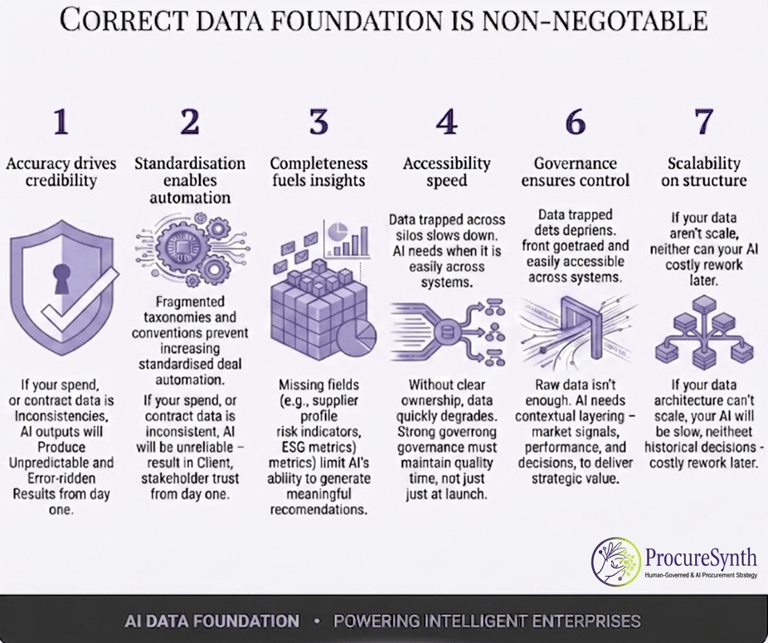
The real reason most AI transformations fail isn't the technology, the vendor, or the strategy. It's that organisations underestimate their data problem rather than fixing it.
The reality is simple: AI transformation is not a technology-first journey — it’s a data-first one.
The CPO I watched leave that organisation wasn't defeated by bad technology or a wrong strategy. She was defeated by an organisation that knew its data wasn't ready — and chose the comfort of delay over the disruption of fixing it. Before you brief the board, ask yourself honestly which organisation you are leading.
SOURCES & REFERENCES
Gartner-(February 2025). Lack of AI-Ready Data Puts AI Projects at Risk
AI assistants for citations and stats check: Claude, for image generation: Gemini Nano
Foundation Assessment
Is Your Organisation Ready for This Conversation?
ProcureSynth assesses your foundation based on predefined metrics and delivers a concrete plan for resolution
Email: connect@procuresynth.com
© 2026 ProcureSynth. All Rights Reserved. ProcureSynth® is a registered trademark of Hemangi Tawade AI Transformation Services.