
The World Got More Volatile. Procurement Budgets Got Tighter. So Why Are AI-Investing CPOs Hitting Their Targets 20% More Often?
Why AI-investing CPOs are outperforming their peers in 2026 — and what DACH procurement leaders need to know before their next board meeting.
WAR ROOM STORIES
Hemangi Tawade
3/26/20265 min read
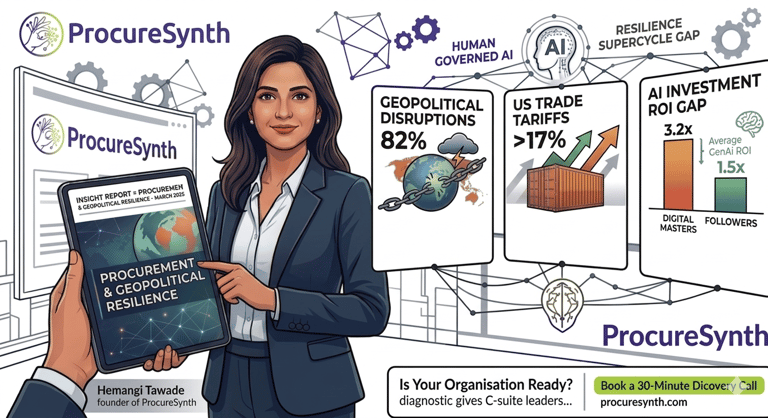
It is 7am on a Monday in January 2026 — a US tariff announcement has just landed, rates surged from under 2% to 17% overnight, and your board wants an impact assessment by end of day. Your suppliers are calling. And your procurement system is showing you last quarter's data.
I remember sitting in the room as IT lead when Covid's first wave hit — figuring out ways to redefine processes. Trying to compress a five-day supplier onboarding process to one day, overnight, under pressure we had never planned for. It seemed impossible until we started looking. And then we found not one way. We found several.
"Every adversity leads to an opportunity. The organisations that find the next way forward are not the ones with the most resources. They are the ones who have built the infrastructure to move."
That was 2020 — manual processes, gut instinct, and experienced people in a room. In 2026, the disruptions are faster, the board timelines are shorter, and the gap between those who are ready and those who are not is wider than it has ever been.
The Board Isn't Asking Whether AI Matters. They're Asking Whether You're Ready.
"Procurement is operating in a world where volatility, complexity and uncertainty are no longer episodic — they're constant."
— Samir Khushalani, Partner, McKinsey & Company
This is not a hypothetical. 82% of global supply chains absorbed this disruption simultaneously. The CPOs who answered that board call with data — not estimates — were already running AI-enabled procurement infrastructure. The rest absorbed the cost of the gap. And some of them stopped being asked back into the room.
This is what operating in a permanently VUCA environment actually looks like — not a crisis to manage through, but a baseline to build for. The organisations absorbing the highest cost right now are not the ones facing the most disruption. They are the ones whose procurement infrastructure was built for a more stable world.
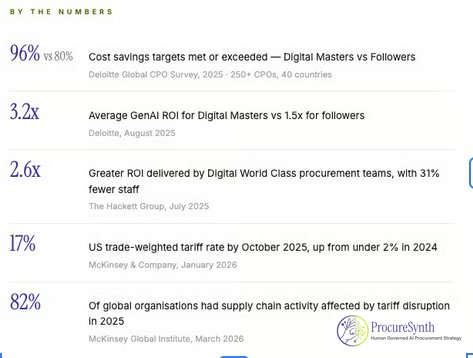
As a CPO in 2026, you are managing something genuinely difficult. US trade tariffs surged from under 2% to 17% in a single year. Geopolitical disruption hit 82% of global supply chains.
And yet your savings targets went up, not down. According to McKinsey's survey of over 300 procurement leaders, 55% are running flat or shrinking budgets while every single respondent faces higher expectations.
In this environment, your board is not asking whether procurement is important. They are asking whether it is ready. And that question — which procurement organisations are genuinely ready to use AI effectively, and which are not — is where the performance gap of 2026 is being decided.
J.P. Morgan calls this "multidimensional polarisation" — where markets are split cleanly between AI-enabled and non-AI sectors — and notes that the role of the CPO has shifted from cost-cutter to Chief Resilience Officer. (J.P. Morgan Global Research, "2026 Market Outlook: The AI Supercycle")
A Gap That Deserves Your Attention
ProcureCon's 2026 CPO Report makes the readiness gap impossible to ignore: 94% of procurement executives use generative AI tools weekly. Only 4% have achieved large-scale deployment. That distance between adoption and impact is not a technology problem. It is a structural one — and it exists inside your organisation before any platform decision is made
“The question is no longer whether AI will transform procurement — it’s how quickly organisations will move, and who will lead.”
— Samir Khushalani, Partner, McKinsey & Company
The Cost of Waiting Is Not Neutral
Deloitte's 2025 Global CPO Survey — drawing from 250+ CPOs across 40 countries — found that procurement organisations classed as Digital Masters met or exceeded their cost savings targets 96% of the time. Those that had not managed 80%. That 16-percentage-point difference is not a future opportunity. It is a cost already being absorbed, every quarter, without a line item.
The Hackett Group's independent 2025 research adds further weight: Digital World Class procurement teams deliver 2.6x greater ROI than peers, operate with 31% fewer staff, and execute sourcing cycles 58% faster. Digital Masters achieved a 3.2x return on GenAI investment. Followers saw 1.5x.
Leading CPOs are now reallocating up to 30% of their traditional infrastructure budgets specifically to fund Agentic AI. They are not doing it for the hype. They are doing it because they are hitting their KPIs 20% more often than their peers.
Speed Is Now a Structural Advantage
Think about what AI readiness actually feels like when a tariff announcement lands at 7am. McKinsey Partner Riccardo Drentin puts it simply:
"In minutes, a change in tariffs can be understood and its effects on the value chain taken into account, then measures can be implemented."
Minutes versus weeks. That is not a marginal efficiency gain — it is a structural lead that compounds with every disruption. The organisations investing in AI procurement infrastructure today will carry 12 to 18 months of operational advantage into every tariff shift, every supply shock, and every board conversation that follows.
The Board Conversation You Need to Have
The most effective CPOs I work with across the DACH region share one approach: they do not walk into a board meeting with a vendor proposal. They walk in with a diagnostic — specifically, ProcureSynth's Procurement AI Friction Index (PAF-I) — a proprietary five-pillar readiness assessment that identifies exactly where structural friction sits before any AI investment is made.
That conversation — grounded in your organisation's actual data, not a vendor's promise — is what turns board scepticism into board confidence. It answers the question your CFO is already asking: not "should we invest in AI?" but "what needs to be true before that investment delivers?"
You do not need more research. You need a clear view of where your organisation stands — and a trusted partner to help you act on it.
Sources & References
McKinsey & Company (January 2026). How AI Can Unlock Value for Procurement. industrytoday.com
McKinsey & Company (October 2025). Transforming Procurement Functions for an AI-Driven World. mckinsey.com
McKinsey & Company (July 2025). A New CPO Playbook: Balancing Resilience, Innovation, and Value Creation. mckinsey.com
McKinsey Global Institute (March 2026). Geopolitics and the Geometry of Global Trade: 2026 Update. mckinsey.com
Deloitte (August 2025). 2025 Global Chief Procurement Officer Survey: Agents of Change. deloitte.com
The Hackett Group (July 2025). Digital World Class® Procurement Teams Achieve 2.6X Higher ROI. thehackettgroup.com
J.P. Morgan Global Research (2026). 2026 Market Outlook: The AI Supercycle. jpmorgan.com
Morgan Stanley (March 2026). AI Market Trends 2026: Global Investment & Risks. morganstanley.com
World Economic Forum (February 2026). How AI-Powered Supply Chains are Shaping Globalisation. weforum.org
CIO.com (March 2026). CIOs Cut Corners to Manufacture Budget for AI. cio.com
Gartner / IT Brief Asia (2026). Government IT Spending Rises as AI Becomes Top Priority. gartner.com
Gartner (2025). AI Agents Will Command $15 Trillion in B2B Purchases by 2028. gartner.com
AI at Wharton (2025). Growing Up: Navigating Gen AI’s Early Years. wharton.upenn.edu
AI assistants for citations and stats check: Claude, for image generation: Gemini Nano
Is Your Procurement Function Ready to Make This Case?
ProcureSynth's PAF-I diagnostic gives C-suite leaders in the DACH region a clear, board-ready view of their AI readiness — and a sequenced plan to act on it, before a single euro is committed.
Email: connect@procuresynth.com
© 2026 ProcureSynth. All Rights Reserved. ProcureSynth® is a registered trademark of Hemangi Tawade AI Transformation Services.