You Deployed AI to Reduce Risk in Your Procurement Function. It Just Created New Ones Nobody Is Governing.
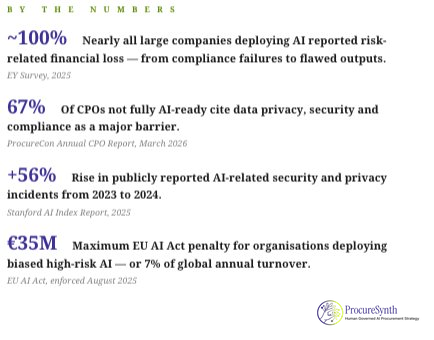
Nearly every large company deploying AI has taken a financial hit from compliance failures or flawed outputs. Most CPOs are running AI pilots without a governance framework in place. That gap is no longer theoretical.
WAR ROOM STORIES
Hemangi Tawade
4/2/20263 min read
You deployed AI to reduce risk. The dashboards look sharper, alerts arrive faster, and decisions feel more data-driven. What was underestimated was the risk the tool itself introduces — and the absence of ownership over how its output is created, interpreted, and acted upon.
The Hidden Risks Nobody Talked About
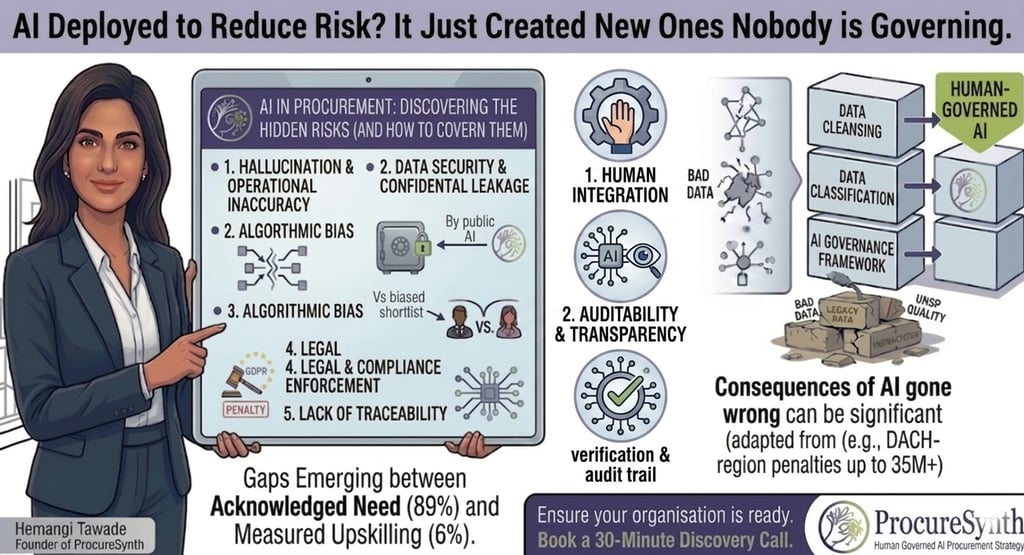
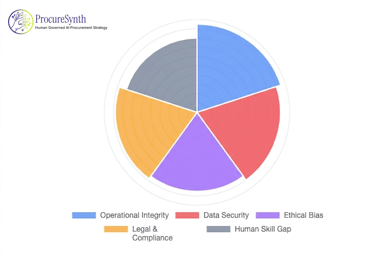
1. Hallucinations and Operational Inaccuracy
In procurement, where contract terms and pricing data must be precise, an AI-generated error presented as fact can drive a catastrophic financial decision. The risk is not the tool malfunctioning. It is teams accepting AI outputs without review.
"Risks emerge when models are trained on incomplete history or when teams accept suggestions without review."
— José Oliveira, VP Product & Technology, Efficio
2. Data Security and Confidentiality Leakage
Procurement handles proprietary pricing, supplier bank details, and strategic contract terms. Processing this data through public AI tools creates a direct confidentiality exposure most organisations have not formally mapped. Only 6% of organisations have begun meaningful AI upskilling despite 89% acknowledging the need — the gap between deployment and governance is where financial exposure accumulates.
3. Algorithmic Bias and Moral Outsourcing
AI trained on historical procurement data learns historical biases. Diverse or newer suppliers are systematically disadvantaged before a human reviews the shortlist. More critically, organisations that delegate ethically sensitive decisions to AI tools cannot delegate the legal accountability that follows.
"A biased AI system may unintentionally favour certain suppliers based on historical data, leading to unfair supplier selection."
— ResearchGate, 2025
4. Legal and Compliance Exposure
The EU AI Act is in phased enforcement from 2025 to 2027. For DACH-region organisations, penalties for prohibited practices reach €35 million or 7% of global annual turnover — exceeding GDPR maximums. Under EU and UK equality legislation, if an AI tool discriminates during supplier selection, the deploying organisation is liable — not the AI vendor.
"The consequences of AI going wrong are severe — we have to be proactive rather than reactive."
— Chris Sawchuk, Global Procurement Advisory Practice Leader, The Hackett Group
5. Decision Risk Without Traceability
AI introduces a parallel decision system that influences outcomes without fitting existing governance controls. IT governs infrastructure. Data teams manage pipelines. Procurement executes decisions. Responsibility fragments. Accountability dissolves.
"80% of organisations now have part of their risk function dedicated to AI — a sign that enterprises are formalising accountability at senior levels."
— IBM Institute for Business Value, 2025
The function that deploys AI to drive decisions must own the governance of those decisions. That accountability sits with the CPO.
From Tool Deployment to Governed System
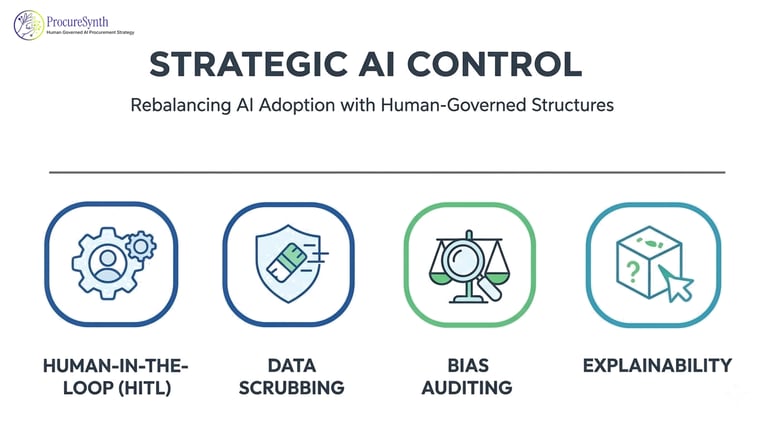
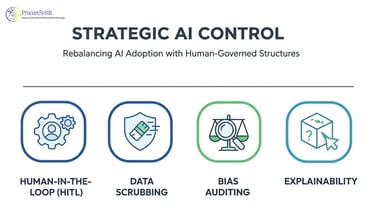
The solution is not to slow AI adoption. It is to build the architecture that makes AI decisions defensible. Four requirements define a governed procurement AI function: human sign-off at every material decision point; named ownership of AI models within procurement; quarterly bias audits on supplier recommendations; and explainability as a non-negotiable procurement standard.
This is not technical governance. It is strategic control
— and it is the CPO's accountability to establish it.
SOURCES & REFERENCES
EY (2025). EY AI Pulse Survey 2025: From AI Adoption to AI at Scale. ey.com
EU AI Act (August 2025). Regulation (EU) 2024/1689 of the European Parliament and of the Council. artificialintelligenceact.eu
ProcureCon Insights / ProcureAbility (March 2026). Industry Study: CPOs Are Taking Charge of AI, Risk, and Growth in 2026. prnewswire.com
Stanford University Human-Centred AI (2025). The 2025 AI Index Report. hai.stanford.edu
Zycus / ProcureCon Indirect West (2025). Panel Discussion: AI Adoption and Governance in Procurement. procurecon.com
Deloitte (August 2025). 2025 Global Chief Procurement Officer Survey: Agents of Change. deloitte.com
McKinsey & Company (January 2026). How AI Can Unlock Value for Procurement. mckinsey.com
The Hackett Group (July 2025). Digital World Class® Procurement Teams Achieve 2.6X Higher ROI. thehackettgroup.com
IBM Business Value, Report 2025.
AI assistants for citations and stats check: Claude, for image generation: Gemini Nano
Foundation Assessment
Is Your Organisation Ready for This Conversation?
ProcureSynth assesses your foundation based on predefined metrics and delivers a concrete plan for resolution
Email: connect@procuresynth.com
© 2026 ProcureSynth. All Rights Reserved. ProcureSynth® is a registered trademark of Hemangi Tawade AI Transformation Services.