You Fixed the Data. You Haven't Fixed the People Governing It.
Most AI procurement transformations stall not at the technology layer — but at the human one.
WAR ROOM STORIES
Hemangi Tawade
4/15/20262 min read
Procurement functions across the DACH region have spent the last three years fixing their data. Cleaner master data. Better taxonomy. Integrated spend visibility. And yet AI transformation is stalling — not in the systems, but in the people sitting in front of them.
The governance gap is human. And most CPOs are not looking there.
Most CPOs who read this will think of someone on their team. Very few will think of themselves.
The Symptom Nobody Names
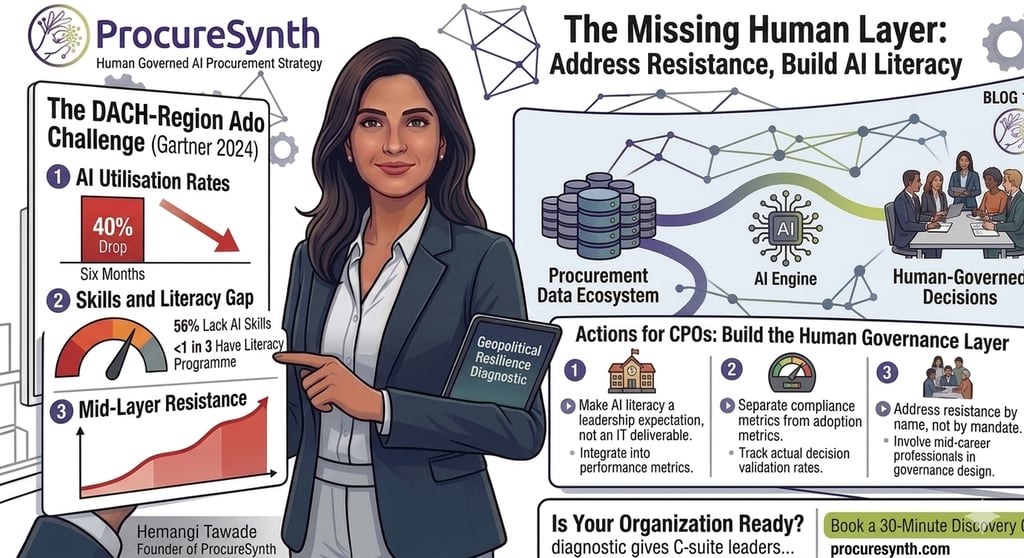
Gartner research shows that 56% of employees believe they lack the skills to use AI tools effectively in their roles — yet fewer than one in three organisations have a structured AI literacy programme in place for non-technical functions.
In procurement, the symptom is specific: teams are not self-directing their capability development. They are waiting to be trained rather than investing in learning prompting, AI-assisted analytics, or output validation. The technology is live. The behaviour hasn't changed.
The Resistance Pattern
The loudest resistance rarely comes from junior staff. It comes from mid-career professionals — experienced, capable, and deeply invested in the workflows AI is designed to replace.
In one organisation, a senior manager stood in front of leadership presenting a side-by-side comparison — enterprise system analytics on one side, AI-generated output on the other. He pointed to a discrepancy and framed it as AI miscalculation. The room accepted it. Nobody asked whether the AI model needed recalibration. Nobody questioned whether the enterprise system was the more reliable benchmark. Management simply reverted to what they knew. The AI tool remained in use. The behaviour it was meant to change did not.
According to McKinsey's 2025 research on AI adoption, organisations that fail to address middle-layer resistance early see AI tool utilisation rates drop by up to 40% within six months of deployment — even where executive sponsorship is strong.
The Leadership Mistake That Compounds It
The default response is mandate. Leadership declares AI adoption non-negotiable, ties it to performance objectives, and monitors compliance.
Compliance is achieved. Transformation is not.
The uncomfortable truth: the CPO who mandates hardest is often the one most uncomfortable having the real conversation — the one about fear, relevance, and what this technology means for careers built on expertise that AI is beginning to replicate. Mandating adoption is easier than addressing that directly. It is also precisely why the problem goes underground.
"The organisations winning with AI are not the ones that deployed the best tools — they are the ones that changed how their people think about decisions."
— Tom Derry, former CEO, Institute for Supply Management (ISM)
Teams report usage. They do not change behaviour.
What Good Looks Like — Three Actions for CPOs
1. Make AI literacy a leadership expectation, not an IT deliverable.
Require procurement managers to demonstrate prompting capability and output interpretation as part of their development review — not as a one-time training box to tick.
2. Separate compliance metrics from adoption metrics.
Track how teams are using AI outputs in decisions — are they validating, overriding, or ignoring them? Usage data without behavioural data tells you nothing.
3. Address resistance by name, not by mandate.
Identify the mid-layer blockers specifically. Bring them into governance design. People who helped build the framework do not sabotage it.
Human governance is not a soft consideration. It is the layer that determines whether your AI investment delivers returns or delivers reports.
Sources & References
Gartner (2024). Employees and AI Skills Gap. Gartner Research.
McKinsey & Company (2025). Transforming Procurement Functions for an AI-Driven World. McKinsey Global Institute.
Derry, T. Cited in ISM and industry coverage on AI adoption in supply management. Institute for Supply Management (ISM).
AI assistants for citations and stats check: Claude, for image generation: Gemini Nano
Foundation Assessment
Are you Ready to have This Conversation?
ProcureSynth assesses your foundation based on predefined metrics and delivers a concrete plan for resolution
Email: connect@procuresynth.com
© 2026 ProcureSynth. All Rights Reserved. ProcureSynth® is a registered trademark of Hemangi Tawade AI Transformation Services.