You Have Diagnosed Your Organisation. Have You Diagnosed Yourself?
In every failed transformation, there is one variable that never gets audited: the person leading it.
WAR ROOM STORIES
Hemangi Tawade
4/16/20262 min read
The SteerCo meeting had been running forty minutes. The sourcing tool deployment was behind schedule. Budgets were under pressure. Then one executive said, quietly but clearly, what everyone else already knew: the team had no freedom to make decisions.
The project lead had been present at every phase. He had reviewed every milestone. He had approved every decision — which is precisely the problem. He believed his presence was leadership. His team experienced it as a ceiling.
The tool had not failed. The data was not the issue. The vendor had delivered. The transformation stalled because the person leading it had not examined the one variable he controlled entirely: himself. He admitted it — after the project had failed, after the savings targets had been missed, after the team had absorbed the consequences of decisions they were never trusted to make.
Most leaders never get that far.
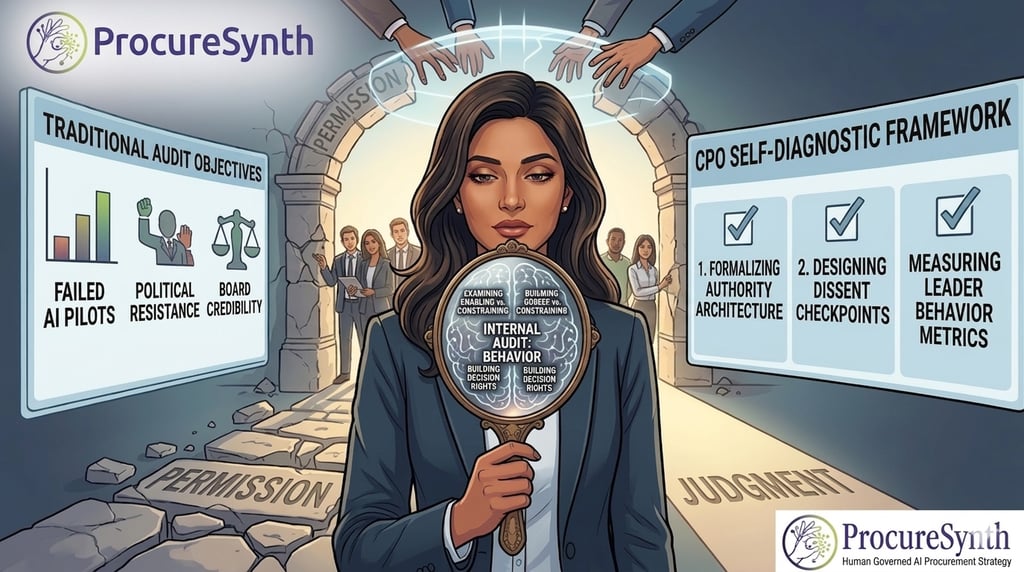
Procurement has spent years building diagnostic frameworks for transformation failure. Volatile markets. Board credibility gaps. Failed AI pilots. Data that wasn’t ready. Political resistance in disguise. Every diagnosis points outward — at the organisation, the data, the technology, the politics. The one audit that rarely makes the agenda is the one that points inward.
“In our experience, it isn’t a lack of knowledge that leads to unsuccessful outcomes. Well-intentioned management teams generally know what needs to be done.”
— Jon Garcia, Senior Partner, McKinsey Transformation Practice
In procurement AI transformation, the gap between knowing and doing is almost always a leadership behaviour problem — and it starts at the top.
“You hired experts to do a job. The most costly thing you can do is not LET Them.”
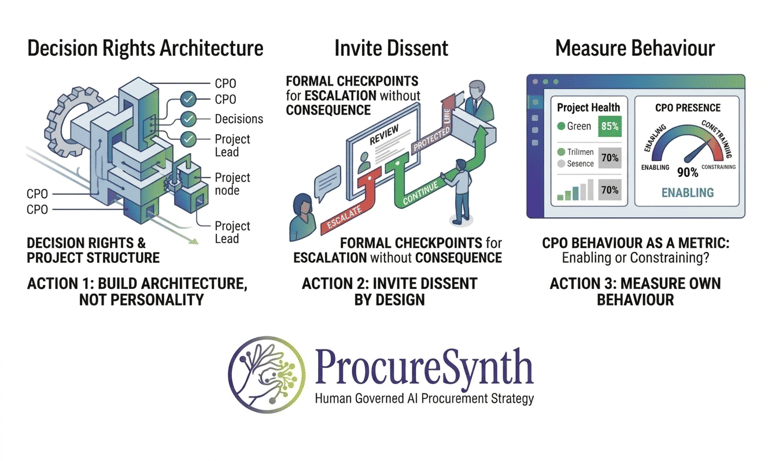
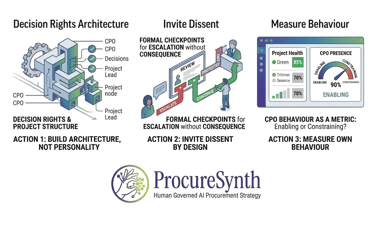
The CPOs who avoid this trap do three things differently. They build decision rights into the project structure before it starts — naming explicitly who owns what, so authority is architecture, not personality. They invite dissent by design, creating formal checkpoints where the team can escalate concerns upward without career consequence. And they measure their own behaviour as a project metric — asking not just whether the transformation is on track, but whether their presence is enabling or constraining the people responsible for delivering it.
The organisations succeeding at AI transformation are not the ones with the best technology or the cleanest data. They are led by CPOs who asked the uncomfortable question first — am I the variable that needs to change? — And answered it honestly.
The leader in that SteerCo room got there eventually. The cost was a failed project, a missed year, and a team that learned to wait for permission rather than act with judgment.
You still have time to ask the question before the failure answers it for you.
Sources & References
Garcia, J. (McKinsey & Company). Common pitfalls in transformations. McKinsey Transformation Practice. mckinsey.com
AI assistants- for citations and stats check: Claude, for image generation: Gemini Nano
Foundation Assessment
Are you Ready to have This Conversation?
ProcureSynth assesses your foundation based on predefined metrics and delivers a concrete plan for resolution
Email: connect@procuresynth.com
© 2026 ProcureSynth. All Rights Reserved. ProcureSynth® is a registered trademark of Hemangi Tawade AI Transformation Services.